As global attention shifts to broader regional conflicts, Caritas Jerusalem‘s medical points in Gaza continue to provide primary care to tens of thousands of people.
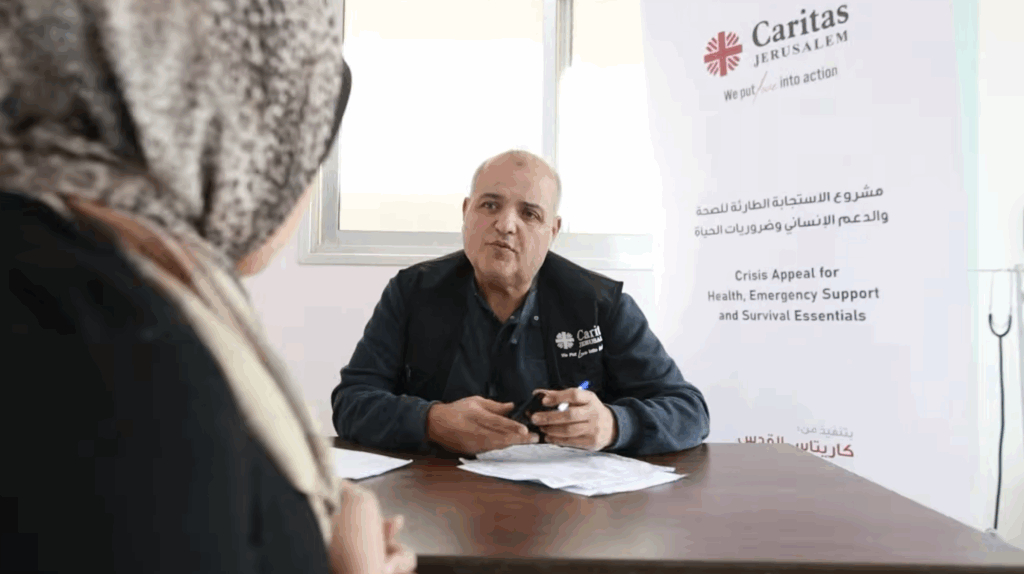
After months of battling a persistent urinary tract issue, Maha visited several hospitals and doctors without finding an effective treatment. Her search eventually led her to Caritas Jerusalem’s Al-Shama’a Medical Point, one of several primary care facilities operating across Gaza. There, a diagnosis was finally made, and treatment commenced, with follow-up care ensuring her full recovery.
Maha’s story underscores the daily struggles faced by nearly two million people still living in Gaza, where the healthcare system has been ravaged by more than two years of conflict. It is almost a miracle that she was able to access care at all.
Clinics in the Rubble
Gaza’s hospitals have sustained extensive damage or destruction during the conflict. To respond to this, Caritas Jerusalem has established a network of mobile medical points: temporary facilities set up in existing buildings or improvised structures strategically positioned near large displaced populations. There is one hospital in northern Gaza City, affiliated with the local Christian parish, and four additional medical points spread across the region.
The Medical Centre in Gaza City was founded in 2003 and has been delivering comprehensive primary healthcare and specialised medical services. The centre includes a fully equipped laboratory for diagnostic tests and provides specialised care such as gynaecology, cardiology, orthopaedics, dentistry, and ultrasound.
It has played a vital role in providing high-quality health services and ensuring access to essential care, even during emergencies and conflicts. Additionally, the centre helps bridge gaps in services offered by the Ministry of Health and supports the work of other health providers in Gaza.
Watch this video about one of Caritas Jerusalem’s healthcare facilities:

Laurens den Dulk, humanitarian programme manager at Cordaid, describes the model of medical points as closer to that of a General Practitioner than to an emergency ward. ‘These are primarily first-line consultations,’ he explains. ‘People come with ongoing medical needs. For the vast majority of people in Gaza, it is exactly the care they cannot get anywhere else.’
Where cases require more specialist intervention, Caritas Jerusalem can refer patients to larger facilities. A small number of the most serious cases are transferred out of Gaza entirely, to countries offering medical support.
Primary Healthcare, Psychosocial Support, Cash Assistance
Cordaid has been supporting its partners in Gaza for several years, funding healthcare services, water and sanitation activities, among other emergency response efforts. Currently, Cordaid supports Caritas Jerusalem’s primary healthcare, psychosocial, and cash assistance programmes in Gaza and the West Bank.
Den Dulk: ‘Helping people deal with their trauma is really at the heart of this. Too often, the trauma is not being processed. It keeps returning and intensifying. However, something very practical and tangible as cash transfers, can also be crucial in this context. They help keep a fragile local economy moving, enabling families to pay rent and allowing teachers and other workers to keep receiving some income in an area where normal employment has almost entirely collapsed.’
‘The situation has not fundamentally changed, but people are not hearing about it.’
Cordaid’s support extends to the West Bank as well. A new contribution to Caritas Jerusalem, covering both Gaza and the West Bank, is being finalised, enabling the organisation to direct funding where it is most needed.
The War That Fell off the Front Page
What strikes Den Dulk most, beyond the operational challenges, is how the crisis in Gaza has vanished from public consciousness, as wider regional tensions now dominate the news.
‘The situation has not fundamentally changed, but people are not hearing about it,’ he says. ‘Gaza was completely closed for weeks at a time, and aid simply could not get in. And now, even as some access has been restored, military operations continue. The difference is that almost no one is paying attention.’
He points to a specific dynamic that worries him: the relative silence around Gaza may actually be enabling further military action. ‘When there is no spotlight, operations can continue without scrutiny,’ he says. ‘That is a real danger. Meanwhile, aid organisations like Caritas Jerusalem do what they can within an environment of profound constraint.’
And then there are the life-threatening risks of operating in areas subjected to ongoing violence. A staff member of Caritas Jerusalem wrote on 26 March:
‘Our teams faced a series of critical incidents over the past 24 hours across multiple locations. Yesterday evening, an airstrike occurred adjacent to our medical point in Deir Al Balah, Gaza. Prior to the strike, we were instructed to evacuate the building to ensure the safety of our staff and beneficiaries. This morning, shrapnel landed near our medical centre in Taybeh in the West Bank, underscoring the ongoing volatility on the ground. At our headquarters in Jerusalem, staff were forced to seek shelter six times due to intensive rocket and missile attacks targeting Jerusalem. Despite these challenges, our operations remain active. Our commitment to those we serve remains unwavering.’
Keep Making Noise
Den Dulk is clear about what he sees as the most important thing humanitarian organisations can do right now, alongside their work on the ground. ‘We have to keep advocating,’ he says. ‘We must keep supporting Gaza, but we also have to keep making noise and insist that this is not over, and that these people cannot be forgotten.’