This practical guide has been developed to support civil society actors in carrying out structured, relevant and effective advocacy throughout the entire electoral cycle. Aware of the crucial importance of free, transparent, inclusive and peaceful elections for strengthening democracy in fragile countries, the guide aims to provide a comprehensive methodological framework, enriched with thematic expertise and concrete case studies drawn from several African countries. Its purpose is to strengthen the capacity of civil society organisations to act at different levels: local, national, regional, and international.
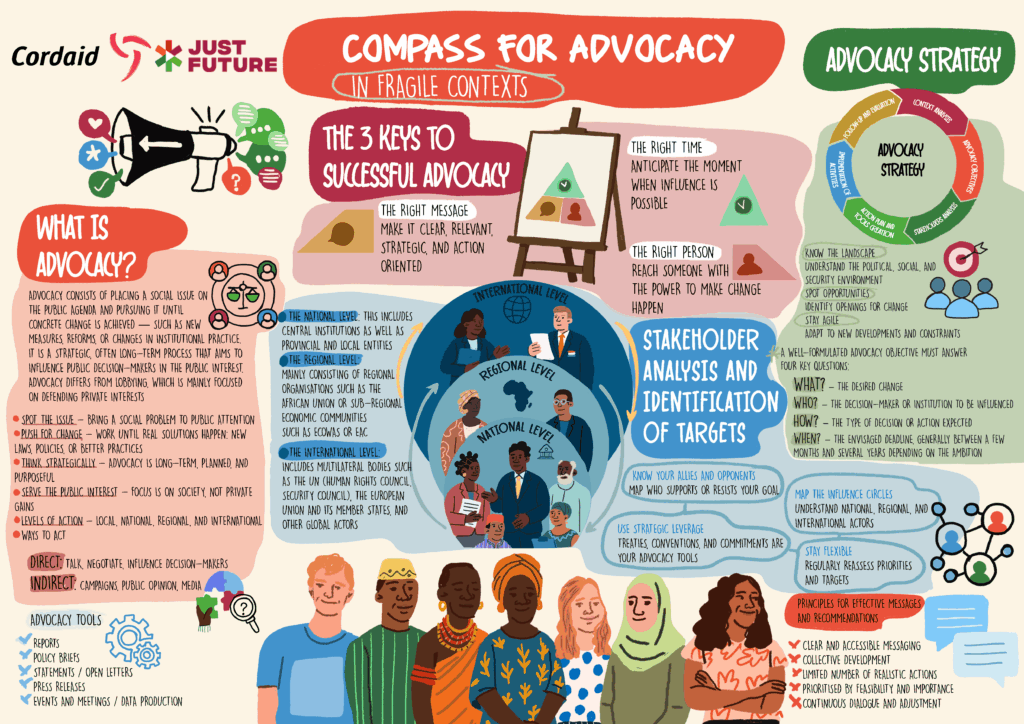
The methodology used to develop this guide is based on a participatory and collaborative approach grounded in the co-construction of knowledge. This approach took shape through an intensive week of interregional exchanges held in Nairobi in April 2025, bringing together experts, representatives of civil society organisations (CSOs), and practitioners of electoral advocacy from five countries involved in the Just Future Alliance (Mali, Niger, DRC, Burundi and South Sudan). These experience-sharing sessions made it possible to build on good practices, identify common challenges, and compare approaches across diverse political and social contexts. They also supported the creation of a Community of Practice (CoP) – a space for mutual learning in which each participant could benefit from the expertise of others while contributing to the development of a shared framework. The lessons drawn from these exchanges, Cordaid’s multi-level advocacy expertise, and the technical contributions of experts from the Electoral Training School in Central Africa (EFEAC) have all been integrated into this guide to ensure its relevance, rigour and adaptability.
This guide is designed to support civil society actors committed to promoting democracy and free, transparent and inclusive elections. It offers practical reference points, flexible tools and a common framework to enhance the impact of their actions on the ground, while remaining adaptable to the specific context of each country.