For the first time in Burundi’s history, farmers can insure their crops against excessive and insufficient rainfall. Jean Marie Vianney Nsabiyumva of Cordaid explains how the scheme works and why scaling it up requires support.
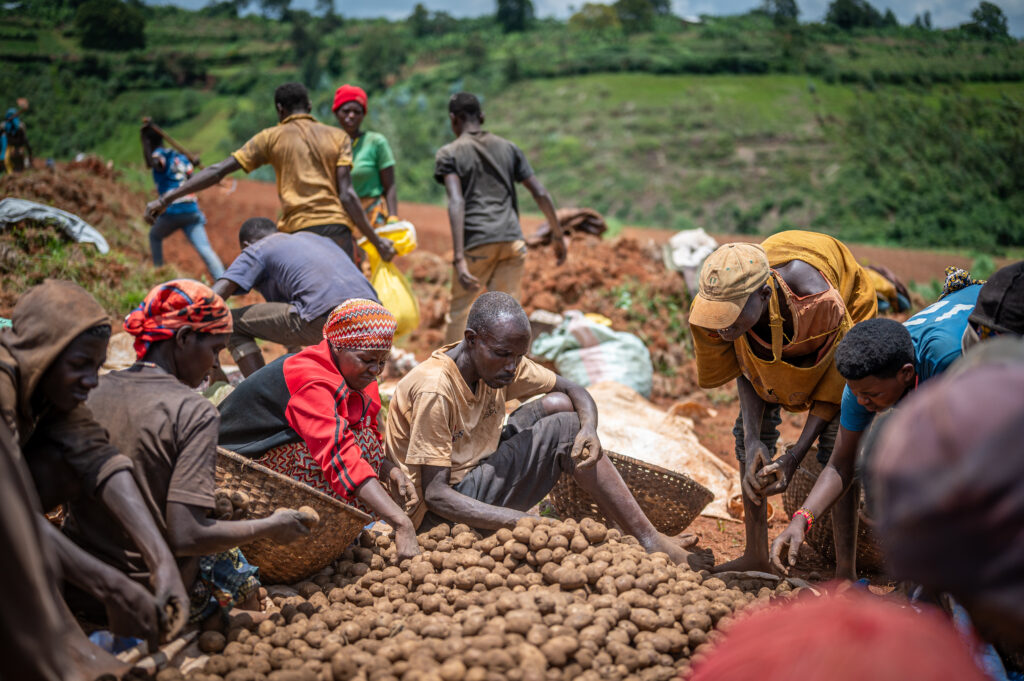
Burundi’s agricultural sector has long been exposed to climate risks that can devastate a harvest and push smallholder families into debt overnight. A new insurance scheme, launched through Cordaid’s PADFIR project with funding from the Embassy of the Kingdom of the Netherlands in Burundi, is seeking to change that.
Seed multipliers and other farmers can now access index-based agricultural insurance covering both rainfall deficits and excesses; the first initiative of its kind in the country. Jean Marie Vianney Nsabiyumva, who leads the project at Cordaid Burundi, spoke to communication officer Rodrigue Niyongabo.
Why is agricultural insurance important?
‘Agricultural insurance has become increasingly important as farming risks grow. In the past, many farmers relied on the simple cycle of planting, cultivating, and waiting for the harvest. Today, climate change has made weather patterns more unpredictable and extreme events more frequent, putting farmers’ investments and livelihoods at greater risk. Protecting those investments is essential. Insurance can help safeguard incomes when shocks occur and strengthen farmers’ credibility with microfinance institutions, making it easier for them to access credit. For these reasons, agricultural insurance is considered a key tool for improving resilience in the sector.
‘Cordaid took the lead in initiating this scheme, which covers both excessive and insufficient rainfall, as either can ruin a farmer. Since we cannot work alone, we partnered with the general insurer Inkinzo.’
‘It also improves farmers’ access to credit. In the past, financial institutions considered agricultural lending too risky, given unpredictable weather and potential crop losses.’
How does it work?
‘All insured plots are geotagged, enabling precise location and monitoring. Using a network of weather stations and a computer model, the insurer estimates the rainfall received on each insured field. When rainfall exceeds or falls below thresholds indicating flood or drought risk, damage is automatically identified using crop-specific indicators.
‘If these thresholds are reached, compensation is triggered. Payments can be made in cash or in kind. They may be provided immediately if there is still time to replant within the same season, or later to support preparation for the next planting season. The premium is determined by the size of the cultivated area, the type of crop, and the level of investment made by the farmer.’
What are the steps to subscribe?
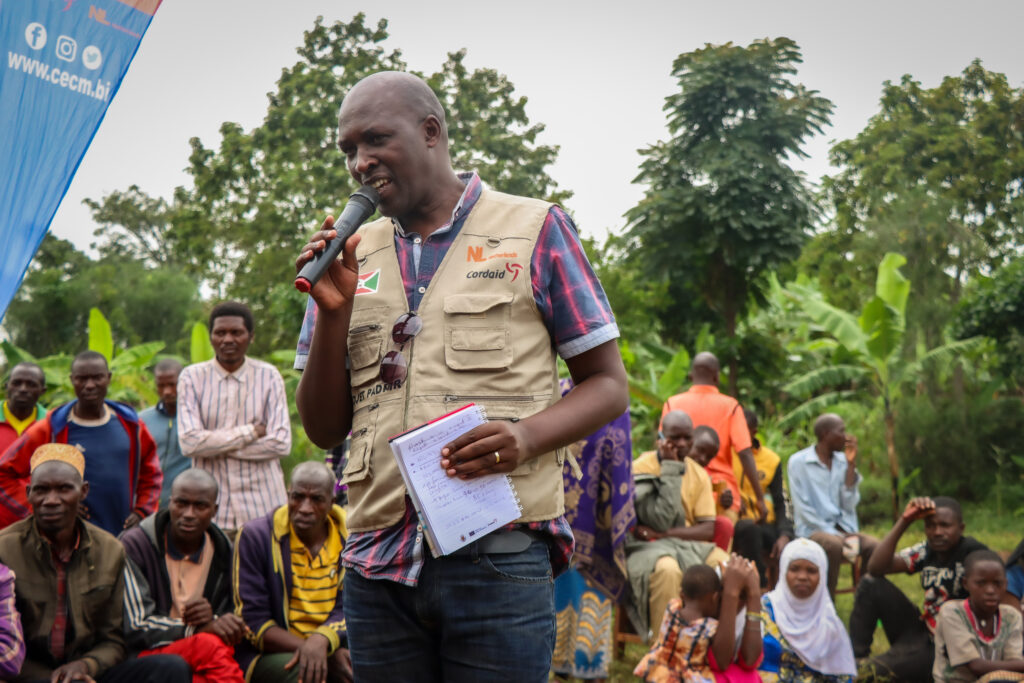
‘Cordaid first organised awareness-raising and promotion among seed multipliers in rural areas. Seed multipliers are the entry point because they support other smallholder farmers and have existing relationships with microfinance institutions. After the awareness phase, follow-up steps ensure clear communication between the insured and the insurer, particularly around how claims are assessed.
‘The insurance can cover different stages of plant development: germination, vegetative growth, flowering, and maturation. At each stage, the farmer declares the state of their crops, and the insurer verifies before any compensation is paid. There is also a subscription deadline to prevent speculation. Someone might otherwise be tempted to take out a policy when they can already see conditions heading towards a disaster.’
Which crops are covered?
‘This pilot programme started with maize, rice, and potatoes. The seed multipliers involved in the initial outreach were primarily growing maize and potatoes; the insurer suggested rice. In practice, farmers most often insure potatoes and maize. Rice is insured less frequently, mainly because it is grown in marshland areas where drought risk is relatively low.’
Who can benefit from the insurance?
‘Anyone growing one of the three covered crops can take out insurance. Cordaid initially promoted it among seed multipliers, but other farmers have since become interested and joined the scheme on their own initiative.’
What are the main advantages?
‘Insurance protects the investments farmers make in their production. In the event of a loss, compensation is calculated based on the inputs invested, providing a degree of certainty that helps secure household income.
‘It also improves farmers’ access to credit. In the past, financial institutions considered agricultural lending too risky, given unpredictable weather and potential crop losses. When farmers have insurance, lenders gain greater confidence that loans can be repaid even when shocks occur. As a result, financial institutions are more willing to extend credit, knowing that insured investments reduce the likelihood of default.’
‘A single adverse event can easily wipe out the modest earnings farmers rely on.’
What risks does the insurance currently cover?
‘At this stage, the insurance covers rainfall risk — both excessive and insufficient — based on needs identified in the field. Other risks, including hail and strong winds in the Migwa region and flooding elsewhere, threaten agricultural production but are not yet covered. Expanding the scope remains a priority for the future.’
What is your message to farmers and development partners?
‘We encourage farmers, as well as technical and financial partners, to continue promoting agricultural insurance. Building a strong culture of insurance requires sustained, collective effort from all stakeholders.
‘As seen in many low-income countries, agricultural insurance markets rarely function at scale without some form of public or donor support. While Cordaid’s project has demonstrated the value of this approach, scaling it up remains challenging without subsidies. A single adverse event can easily wipe out the modest earnings farmers rely on.
‘We are calling on the government and development partners to support agricultural insurance through long-term subsidies. Agriculture has been identified as a national priority under Burundi’s Vision 2040 development goals, and insurance is a practical tool for protecting that sector.’