A rare strain of Ebola with no approved vaccine or treatment is spreading rapidly across the Democratic Republic of Congo, pushing an already fragile humanitarian system to its limits. As cases cross regional borders, aid organisations, including Cordaid, are on the ground, training health workers, distributing protective equipment and running community awareness campaigns in a race to contain the outbreak before it widens further.
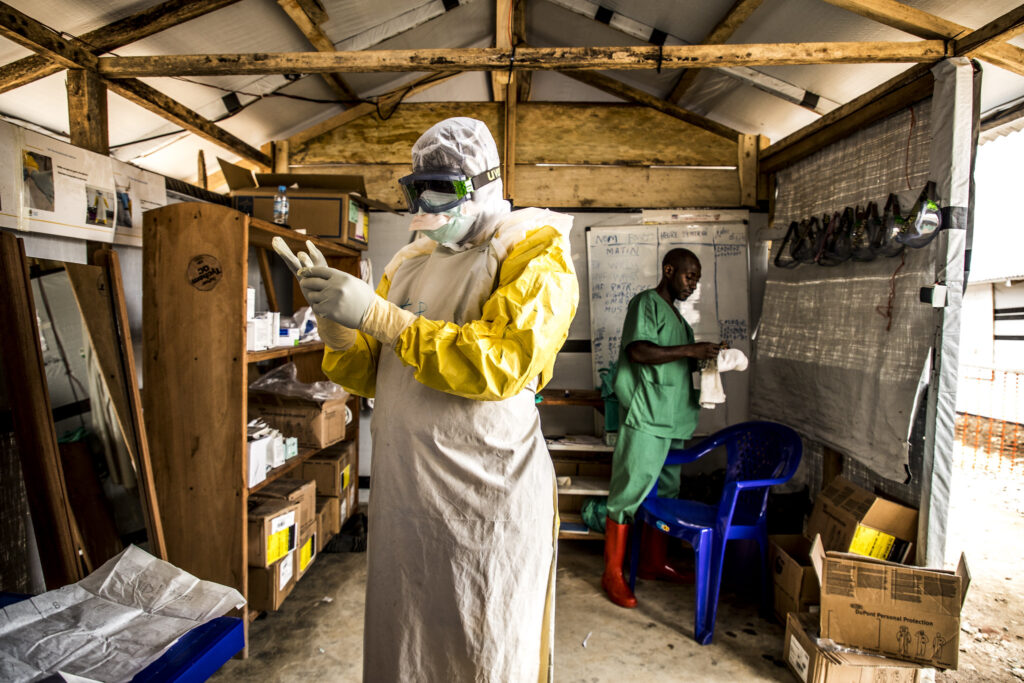
The current outbreak in the Democratic Republic of Congo (DRC) is caused by the Bundibugyo strain of the Ebola virus, one of four variants known to cause severe illness in humans. Unlike the more familiar Zaire strain, responsible for several earlier outbreaks in Congo, and for which vaccines and treatments now exist, the Bundibugyo variant has no approved medical countermeasures. There is no vaccine to administer, no established treatment protocol to follow.
Since the outbreak was identified, more than a thousand suspected and confirmed cases have been recorded, along with nearly 250 suspected and confirmed deaths. The WHO has assessed the risk of cross-border spread as high, and cases have already been reported in neighbouring Uganda.
The virus, first identified in 1976 by Belgian scientist Peter Piot in a remote part of the Congolese rainforest (named after the nearby Ebola river), spreads through direct contact with bodily fluids, including blood, saliva and faeces. It does not travel through the air or via insects.
Symptoms typically appear within two to 21 days of exposure and can resemble malaria in the early stages: fever, fatigue, vomiting and muscle pain. But they escalate quickly. The virus attacks the immune system, triggering internal bleeding and ultimately causing organ failure. In Africa, fewer than half of those infected survive.
An Already Fragile System under Pressure
The situation is most acute in the DRC’s Ituri province, where the outbreak is centred. It was not until 1 June that an Ebola treatment centre opened in Bunia, a city of around one million people.
Community distrust has led to attacks on burial teams attempting to carry out safe and dignified procedures. Supply shortages are hampering the response at every level: essential medicines are running low, laboratory sample transport between Ituri and Kinshasa is unreliable, and contact tracing remains weak.
The provinces of North and South Kivu are almost entirely cut off, with closed borders, suspended commercial flights and frozen banking. Travel restrictions imposed by Uganda and Rwanda, combined with mandatory approval processes for humanitarian flights, are hampering not only the emergency response but also the broader economic and development work on which communities depend.
‘Ebola is a very serious problem,’ says Lisette Ridja-van ‘t Klooster, Cordaid’s programme director for the DRC. Although the epicentre is in Ituri, there are already multiple confirmed cases in North and South Kivu. We are scaling up our programmes there now to try to stop the virus from spreading further.’
Humanitarian Workers Feel the Strain
The outbreak is not an abstraction for aid workers in the field. Colleagues based in Ituri report that deaths are occurring with increasing frequency in communities close to where they work, including among health workers, a group facing disproportionate exposure. Last week, a suspected Ebola-related death was reported at a health centre directly adjacent to Cordaid’s office.
Esther Birhega, HR officer for eastern DRC, works from Cordaid’s office in Goma. ‘Our colleagues in Bunia are deeply worried,’ she says. ‘Especially about their children going to school and the risk of exposure there. And they see that the authorities are not well-equipped to respond effectively.’
Of Cordaid’s seven staff members in Ituri, two were outside the province when the outbreak began and have not yet returned due to travel restrictions. ‘Our staff in eastern DRC understand exactly how to promote safe behaviour in this context,’ Birhega adds. ‘But understanding is not enough to keep them safe when so many cases go officially undeclared.’
Cordaid has put in place contingency measures, including provisions for staff to work from home should a suspected case arise within their team.
Cordaid and Its Partners Are Responding
Cordaid, together with local and international partners including Caritas Bunia, Caritas Belgium, Trócaire and CAFOD, is delivering a range of interventions. Community awareness sessions are being held to explain how the virus spreads and how to prevent infection. Hygiene kits, including handwashing stations, soap, chlorine, buckets and jerry cans, are being distributed in affected areas. Healthcare workers are receiving dedicated Ebola training along with protective equipment, including gloves, face masks, protective clothing, and face shields.
This is not the first time Cordaid has responded to an Ebola crisis in the region. During the 2013–2016 epidemic in West Africa — the largest in recorded history, which killed more than 11,000 people across Guinea, Liberia and Sierra Leone — Cordaid worked throughout the outbreak and its protracted aftermath, supporting medical care, safe burials, community education and hygiene distribution.
Awareness Saves Lives
The spread of misinformation is complicating the current response. Rumours and traditional treatment advice circulating in affected communities are undermining public health messaging, while low reporting rates across all three affected provinces mean the true scale of the outbreak remains unclear.
Health systems in eastern DRC were already stretched before the outbreak began. Years of conflict have left infrastructure damaged, healthcare access limited, and populations constantly displaced, factors that make controlling any infectious disease considerably harder. What is clear is that awareness saves lives. When communities understand how Ebola spreads and can recognise its symptoms early, the chain of transmission can be broken.