In a busy corner of the market in Juba, the capital of South Sudan, you can hear the rhythmic sound of Awate Lonah’s sewing machine. As a participant in a programme that supports people in rebuilding their livelihoods, she found financial independence and gained confidence in a better future.
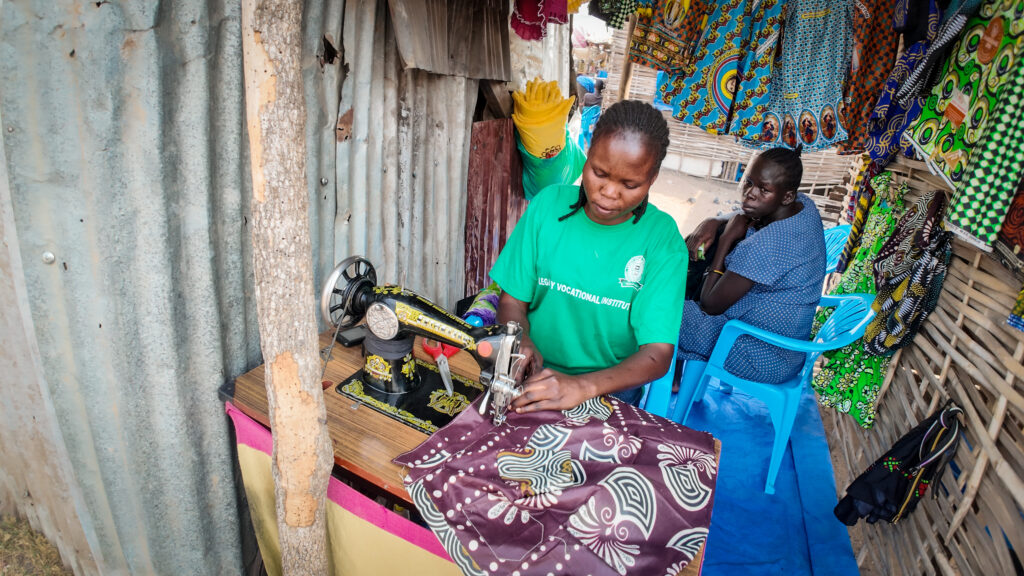
‘After finishing the training, I established my own sewing stand at the market, and now I can support my family,’ Awate says. ‘I also started learning new designs online, which has brought me many more customers. Now I am teaching other women how to sew.’
Across South Sudan, conflict, displacement, and economic hardship have left displaced persons, returnees, and host communities struggling. In the Juba and Magwi Counties, households still lack reliable access to income, clean water, and basic services, such as health care and education. Women and girls are often hit hardest, as they often spend long hours fetching water instead of learning or earning income.
Creating Opportunities, Strengthening Resilience
The project, Integration, Stabilisation, and Capacity Building of Internally Displaced Persons, Returnees, and Host Communities in South Sudan to Improve Living Conditions and Peaceful Coexistence, is helping communities move from survival to resilience.
With funding from BMZ through Gesundes Afrika and in partnership with Action for Community Health, Cordaid is empowering communities across Juba and Magwi Counties to rebuild their livelihoods.
Through poultry farming, vegetable production, liquid soap making, reusable sanitary towel production, and tailoring, families are strengthening their food security while generating sustainable income to meet household needs, investing in their children’s education, and building more resilient livelihoods.
In Juba and Magwi County, 100 women and youth graduated from vocational training in reusable sanitary towel production and basic business skills, while 60 completed tailoring and fashion design courses and received sewing machines as start-up kits.
Many now run garment stalls in local markets, producing clothing and sanitary towels, important and dignifying means for the health of women and girls, while opening pathways to livelihoods that extend beyond the project itself, as Awate’s story shows.
Watch this short video documentary about the project:

Communities Leading Their Own Progress
Households are also building long-term resilience through Village Savings and Loan Associations, which help them save, reinvest, and grow their businesses beyond the project’s life. Communities are contributing too; residents worked with local government to voluntarily provide land for boreholes and watershed infrastructure.
‘Our role is to create opportunities, provide resources, and support communities in putting their ideas into practice,’ says Lino Singer, Head of Programmes at Gesundes Afrika.
The results are visible. Farmers are expanding production beyond initial project support, women entrepreneurs are voluntarily mentoring others, and water committees are independently collecting maintenance fees to sustain infrastructure.
Clean Water, Restored Dignity
Access to clean water has also improved significantly. In Magwi County, 10 boreholes were rehabilitated, and 5 more in Juba County. Solar-powered systems with Lorentz smart-tap technology were installed in Nimule and Lologo II. About 2,000 households now benefit from cleaner water.
Community water management committees oversee these facilities, ensuring inclusive and accountable service beyond project support. A three-month hands-on training programme also built a local pool of pump mechanics skilled in borehole maintenance and hygiene promotion, reducing dependence on outside technical assistance.
‘A community should be able to say: although the season has ended, we have enough savings and resources that allow us to continue growing,’ says Tom Otieno, Country Director for Cordaid in South Sudan.
Rebuilding lives takes time, but stories like Awate’s show that when communities gain skills, take ownership, and connect to opportunity, progress follows. Through community-led solutions, families across South Sudan are restoring dignity, strengthening resilience, and building pathways toward peaceful coexistence and a more sustainable future.