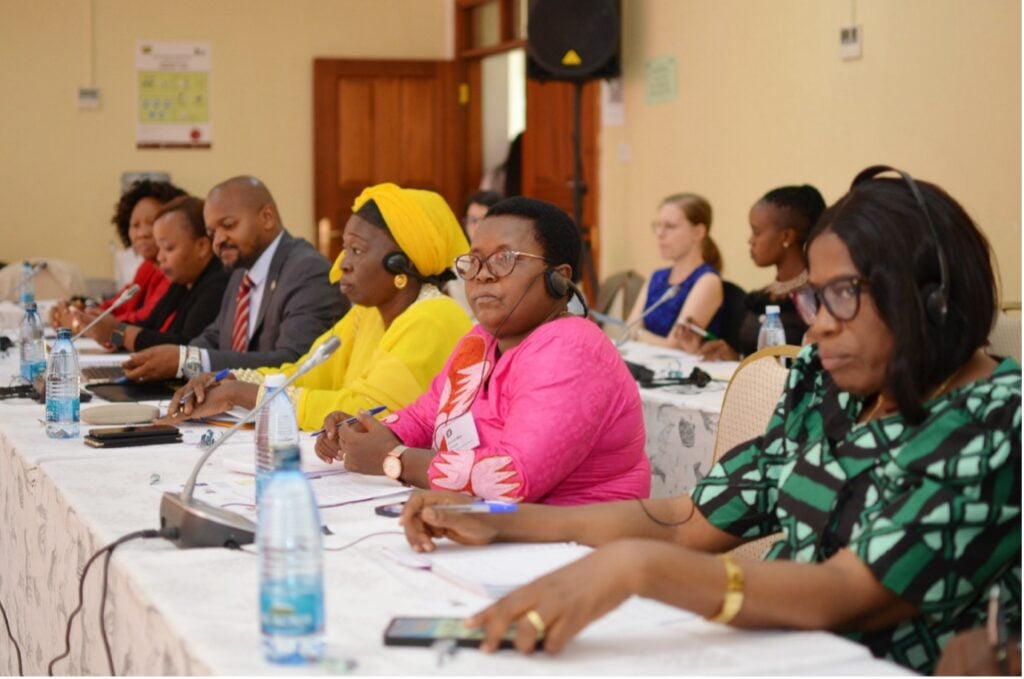
To deliver for communities, the partners combined evidence, expertise and access to influence decisions at all levels, from local committees to global human rights mechanisms.
Working across these levels helped partners translate community priorities into policy and practice changes. The numbers speak for themselves: over five years, Just Future strengthened 249 civil society organisations and contributed to changes in 36 laws and decrees. The following examples illustrate how partners achieved these results.
Grassroots Voices at the Centre
In the Democratic Republic of Congo (DRC), Just Future supported a coalition of more than 120 civil society organisations in bringing community concerns to the UN Human Rights Council through the Universal Periodic Review (UPR), a mechanism through which UN member states examine one another’s human rights records and recommend improvements.
The advocacy began with communities identifying what needed to change to protect their rights. Cordaid and its partners brought those demands to the diplomatic delegations of UN Human Rights Council Member States in Geneva, helping secure recommendations that the DRC government accepted. Community concerns became official commitments through the UPR, providing civil society with a basis to press for action and hold authorities accountable.
‘When grassroots voices are placed at the centre, and local organisations work hand in hand with international partners, change becomes possible,’ says Davide Soto Naranjo, Cordaid’s security and justice expert, who coordinated the effort. ‘Locally led coalitions, backed by strong partnerships, can ensure community concerns are heard at the Human Rights Council and turn them into lasting commitments.’
‘Policymakers want to hear different and new perspectives coming directly from the field. The moment you achieve that, half the work is done.’
Bringing Community Concerns to the UN Security Council
In the DRC, decisions on MONUSCO, the UN peacekeeping mission, directly affected communities already facing violence and displacement. As the Security Council considered the mission’s withdrawal in 2024, Just Future partners organised roundtables in Kinshasa and at the UN Security Council in New York. Congolese civil society representatives discussed community concerns directly with Council members, including France, which led the drafting of the resolution.
This engagement helped secure stronger commitments to protecting civilians and human rights in the resolution adopted in December 2024. The alliance connected organisations documenting insecurity in the DRC with diplomats negotiating the mission’s future.
Teodora Nguen, advocacy and positioning advisor at Cordaid, believes the combination of research and first-hand testimony gave the message its weight. ‘Policymakers want to hear different and new perspectives coming directly from the field,’ she says. ‘The moment you achieve that, half the work is done.’
Communities Shaping Their Own Security
Where mistrust between communities and authorities runs deep, the starting point is for communities to articulate their security priorities and help shape the response.
Since 2021, in South Sudan, national partners CEDAR and the South Sudan Law Society have helped establish Police-Community Relations Committees, bringing together block leaders, traditional chiefs, and women’s and youth representatives alongside police, wildlife and prison officers.
Adiga Rahman, CEDAR’s country programme director, has seen the effect first-hand. ‘When everyone feels represented, the committee gains the legitimacy to act on behalf of the community,’ he says. ‘Because security issues are often sensitive, that legitimacy is crucial.’
Information shared through the committee prompted the launch of night patrols that broke up gangs responsible for a string of assaults. Sustained pressure from the committee also helped women reclaim market land that had been handed to a private investor. ‘Successes like this give women the experience and confidence to advocate for their own needs and rights,’ Rahman adds.
‘We feel empowered knowing we have colleagues we can always call on for support and ideas to navigate our challenging context.’
Young People Shaping Peacebuilding
Across the programme, capacity strengthening proved most effective when training was paired with ongoing coaching and joint advocacy, enabling partners to develop and apply their skills in practice.
The West Africa Network for Peacebuilding trained around 100 young people across 15 countries in advocacy and mediation skills, and then put that training to immediate use. At a 2024 youth summit in Accra, delegates from Mali and Niger presented a five-point advocacy document directly to UN officials. ‘Meeting young people from other parts of the region has given us strength,’ says Mariama Chitou Mahamadou, a youth leader from Niger. ‘We feel empowered knowing we have colleagues we can always call on for support and ideas to navigate our challenging context.’
The Challenges Ahead
By the numbers, the score is substantial. But Cordaid’s evaluation is equally clear-eyed about the challenges. Structures such as South Sudan’s National Steering Committee now face an uncertain future as programme funding ends. Several national organisations warn that losing support for basic running costs threatens their survival, even as the networks they built continue to matter.
For Cordaid, these findings reinforce the need for local partners to have greater control over decisions and resources. Taking on more responsibility must be accompanied by the funding and agency to carry the work forward, and by accountability to the communities they represent.
A New Partnership for Women, Peace and Security in Mali and Niger
Cordaid will bring lessons, experience and know-how gained through Just Future to a new partnership with the Dutch Ministry of Foreign Affairs on Women, Peace and Security in Mali and Niger. Funded under the Ministry’s FemFocus framework, the €13.3 million programme will run from July 2026 to June 2031.
It will support women’s leadership in peace and security processes, strengthen women-led organisations and expand survivor-centred services for people affected by conflict-related sexual violence. Experience from Just Future will inform how the partnership combines flexible financing, capacity strengthening and advocacy to help implement national Women, Peace and Security commitments.