In Kisii County, western Kenya, a former teacher has built a thriving circular farming enterprise on less than a quarter of an acre, using little more than organic waste and a good dose of ingenuity.
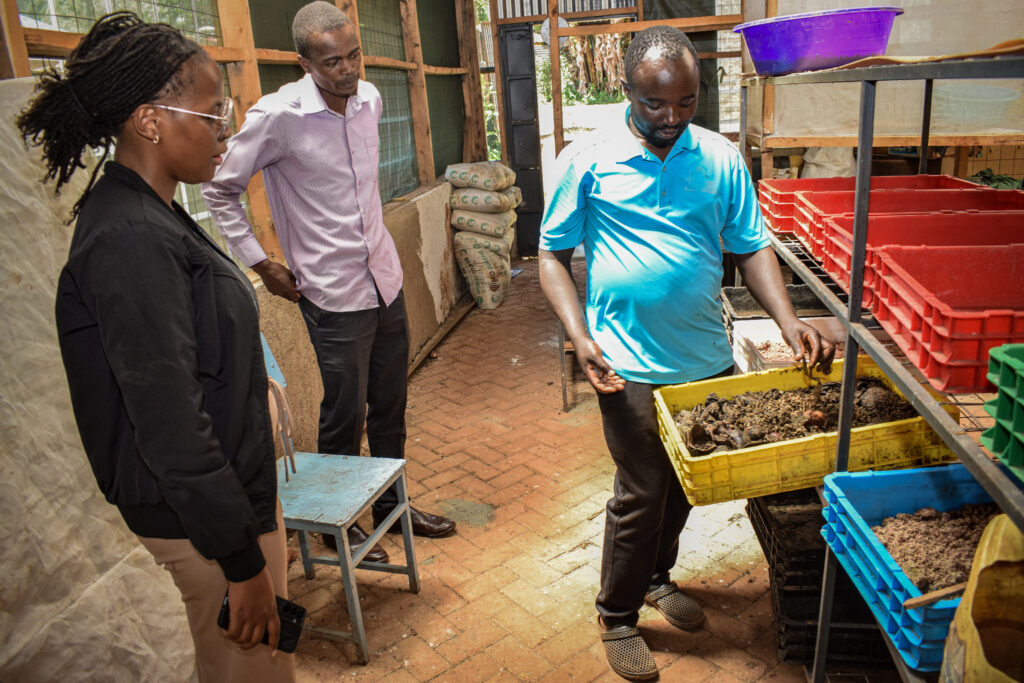
Trained as a secondary school teacher of mathematics and geography, 37-year-old Cleophas Obwogi, father of three, found himself unable to secure stable employment after qualifying. ‘I chose to become self-employed as an agripreneur,’ he says.
As the eldest child in his family, Obwogi had grown up working the land alongside his mother and occasionally laboured on neighbouring farms. That early exposure, he says, laid the foundation for what eventually became a career.
He went on to establish Obifam Enterprises, a small farm in the densely settled hills of Kisii that has since become a reference point for farmers, young people and agricultural professionals from across Kenya.
Pig Waste
Obwogi began with pig farming, but the enterprise quickly ran into difficulties familiar to smallholders across the region: scarce land, high feed costs, and limited access to technical knowledge and credit.
Most pressingly, the accumulation of pig waste was creating serious problems. The smell was persistent. Neighbours complained. Local authorities took note.
‘Waste is not waste until it is wasted,’ Obwogi says now. At the time, however, the situation was threatening to unravel his business and his relationships with the surrounding community.
Black Soldier Fly Farming
Searching online for a solution to his waste management crisis, Obwogi came across black soldier fly farming, a technique in which larvae are raised on organic matter, producing high-protein feed as a by-product.
He was sceptical but intrigued. He purchased one kilogram of starter stock from a farmer in neighbouring Kisumu County, secured a rented plot nearby, and began experimenting.
The results exceeded his expectations. The larvae fed on organic waste from his piggery, poultry and local market sources, consuming material that had previously been a liability. In return, they produced two valuable outputs: the larvae themselves, a protein-rich feed supplement, and frass, the residual matter left after the larvae have processed organic waste, which functions as a high-quality organic fertiliser.
‘Currently, I am practising livestock farming and organic horticulture together,’ Obwogi explains. ‘I use organic waste from my farm to rear black soldier flies. The process produces high-protein maggots that I use as animal feed and also sell, as well as frass, which serves as organic manure for my farm and for sale.’
A Business That Feeds Itself
The model has since grown substantially. Obwogi now produces around 30 kilograms of larvae daily, generating approximately 78,000 Kenyan shillings per month (roughly 520 euros) from larvae sales, manure and training services. He sells starter stock to other farmers at between 4,000 and 5,000 shillings per kilogram, and has reduced his own livestock feed costs by around half.
The odour complaints have stopped. Local market traders now bring him their organic waste rather than discarding it. He employs young people and women from the surrounding area, and hosts regular farm visits from individuals and groups seeking to replicate what he has built. His work has been featured on national television and earned him recognition and small community grants to improve his farm infrastructure.
Obwogi has diversified into organic horticulture, goat rearing and poultry alongside his fly farming operation, though space constraints limit the scale of these activities. Black soldier fly farming remains the centrepiece, and the innovation he considers most transformative.
Rural Kenya Financial Inclusion Facility
Obwogi’s enterprise was identified by the Rural Kenya Financial Inclusion Facility (RK-FINFA), a six-year project funded by the Kenyan government and the International Fund for Agricultural Development. The initiative targets 190,000 rural households across 14 counties, with a focus on financial inclusion, green investment and capacity building for youth and women.
Through the project, Obwogi received training in entrepreneurship, financial literacy, record keeping and business planning, skills that have helped him rethink his model and plan for growth.
Cordaid provides technical support to smallholder farmers and microfinance institutions across seven counties in western Kenya and is now helping him access green finance to further scale his operations.
Obwogi is ambitious. He wants to expand production to become one of Kenya’s leading black soldier fly producers, enter commercial animal feed and organic fertiliser manufacturing, and extend his environmental work to include inorganic waste management. He also intends to keep mentoring other farmers and young people interested in following a similar path.