Four years after Russia launched its full-scale invasion of Ukraine, the war continues to reshape millions of lives. Homes have been destroyed, families scattered, and entire communities displaced. Through its partners Caritas Ukraine and Caritas Spes, Cordaid has been working across the country to provide emergency support to those caught in the conflict. These are six of their stories.
Nothing to Return to
Police officers helped Victoria reach the transit evacuation point in Oleksandrivka from her home city of Dobropillya. ‘The walls in my apartment were shaking, and bombs were constantly falling in our area. It’s terrifying. I just don’t have the strength anymore.’
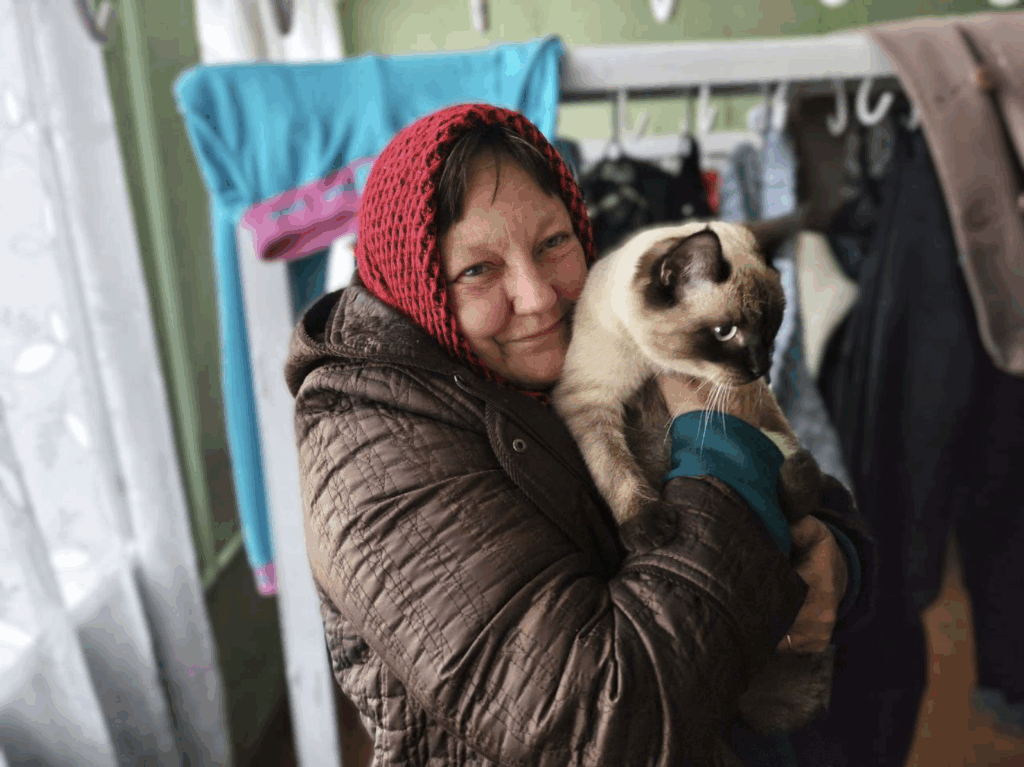
She brought her documents, a few bags of belongings, and her cat, Malyuk, whose purring offered some comfort as Victoria spoke through tears about life in a frontline city. At the evacuation centre, the Caritas staff surrounded her with care.
Next comes a transit centre in Pavlohrad, and then Poltava, where her daughter and grandson are waiting. ‘It’s hard, but I understand that I’m unlikely ever to return home, because there will be nothing to return to,’ she says.
Keeping the Cold Out
Viktoriya Lukyanova fled the Pokrovsky district of the Donetsk region with her four children and settled in Poltava. Adapting to a new place was hard enough, but the approach of winter made an already difficult situation acute.
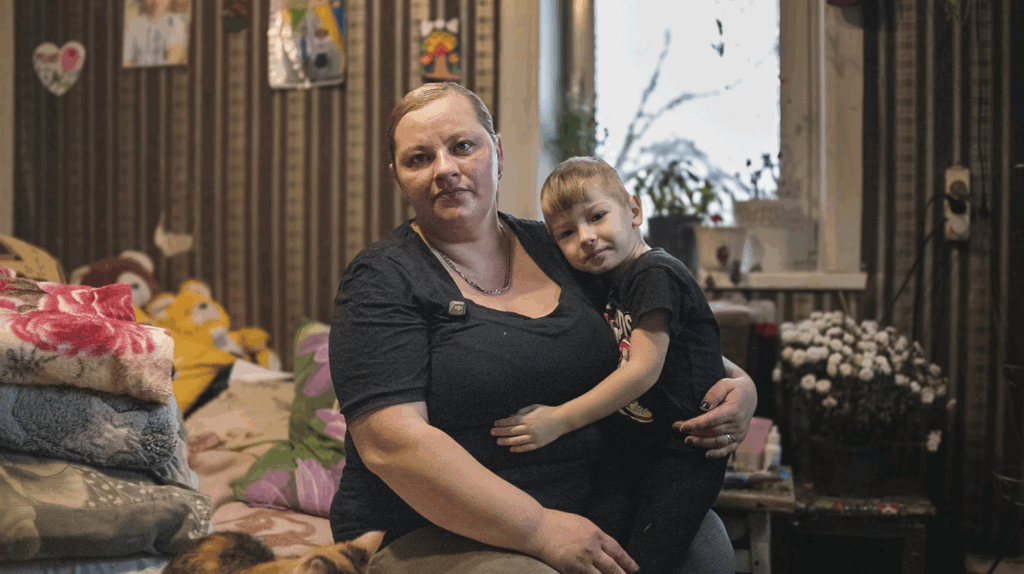
‘One day I learned about Caritas and that you can get help against the winter cold,’ she recalls. ‘So I reached out.’
Having submitted the necessary documents as a displaced mother, Viktoriya received financial support. The money went toward pillows, blankets, and utility bills, the essentials for a stable, warm winter in an unfamiliar home.
Finding Safety
Tetyana (85 years old) describes her village in the Pokrovsky district: there is a shell hole in the house opposite hers, drones circled overhead, and the neighbouring street has been destroyed.
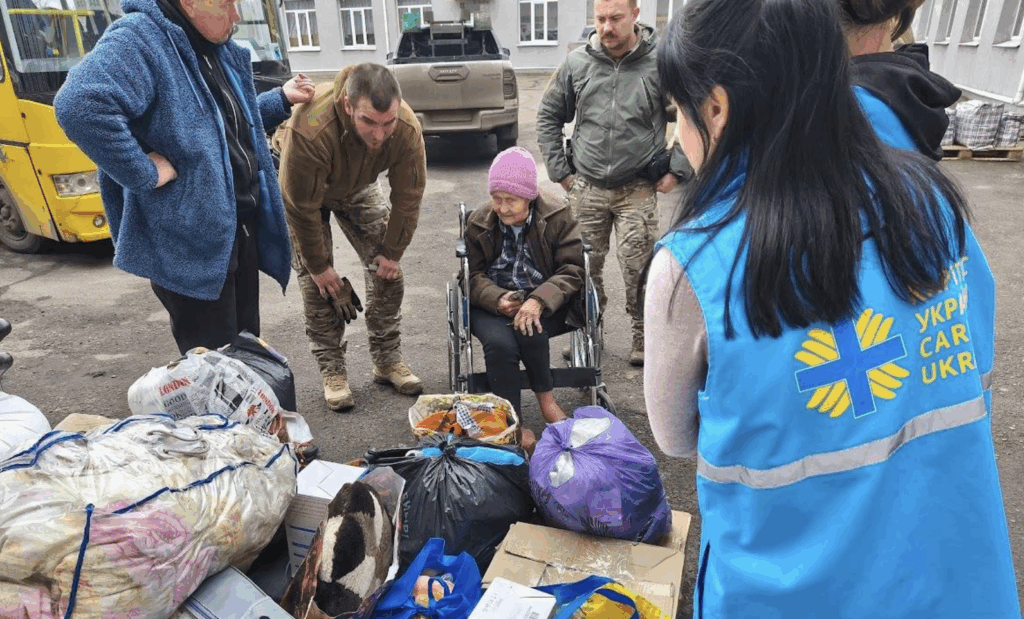
‘I’m not afraid of death, but I really want to live,’ she says at the evacuation point in Oleksandrivka. ‘What scares me most is the thought that my house will be hit or I will be seriously injured, and there will be no one to save me.’
At her age, with a disability and no relatives left in the country, that fear became the reason she finally left. Her lifeline is Svitlana, a social worker who had previously supported Tetyana and had fled to Dnipro with her own family. Svitlana ensured Tetyana had a place to stay.
‘She called me and told me they had already prepared a room for me,’ Tetyana says. At the evacuation centre, she warmed herself with hot tea and spoke with the Caritas team before continuing her journey to Pavlohrad and, from there, to safety.
Two Bags Containing a Lifetime
Anatoliy Oleksandrovych has lived his entire life in a village near Kurakhove. The house his father built in 1949 was solid enough to have stood for decades more, but shells destroyed several neighbouring homes and left his own severely damaged.
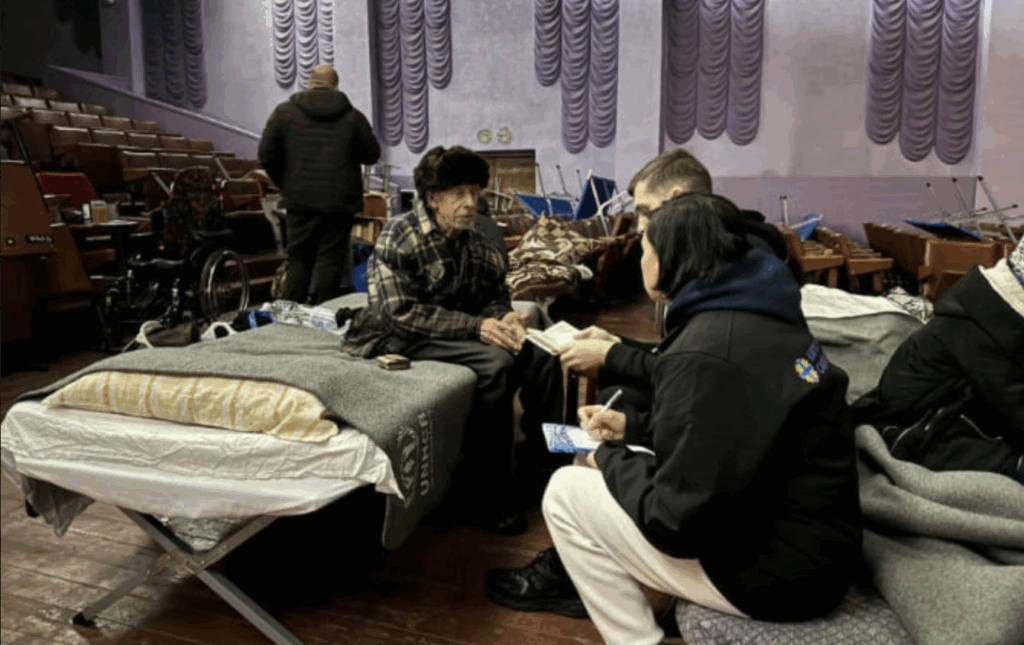
Life has already taken much from him. Both his sons died in tragic circumstances years ago. His wife passed away in 2007. Now he has lost his home. He left with only two bags.
He struggles with his hearing and sight, and his legs give him trouble, but his spirit remains intact. His one real worry before leaving was a bag of family photographs he feared he had left behind.
The Caritas evacuation bus took him to a safer region, where he will be housed in a retirement home. The team gave him food for the journey and a listening ear.
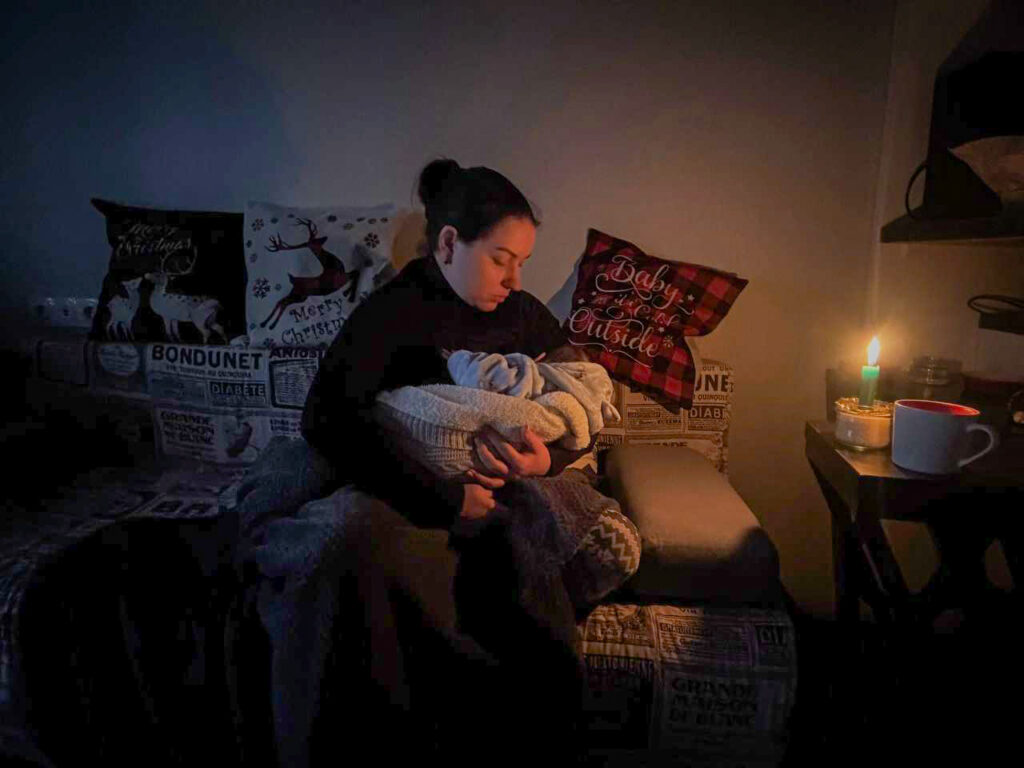
Keeping Your Baby Warm in a City Without Power
Maryana lives in Kyiv with her three-month-old daughter. Her apartment building has an individual gas boiler, but it runs on electricity. When power cuts 10 hours or more — which they often do — the temperature inside can drop to 13 degrees Celsius.
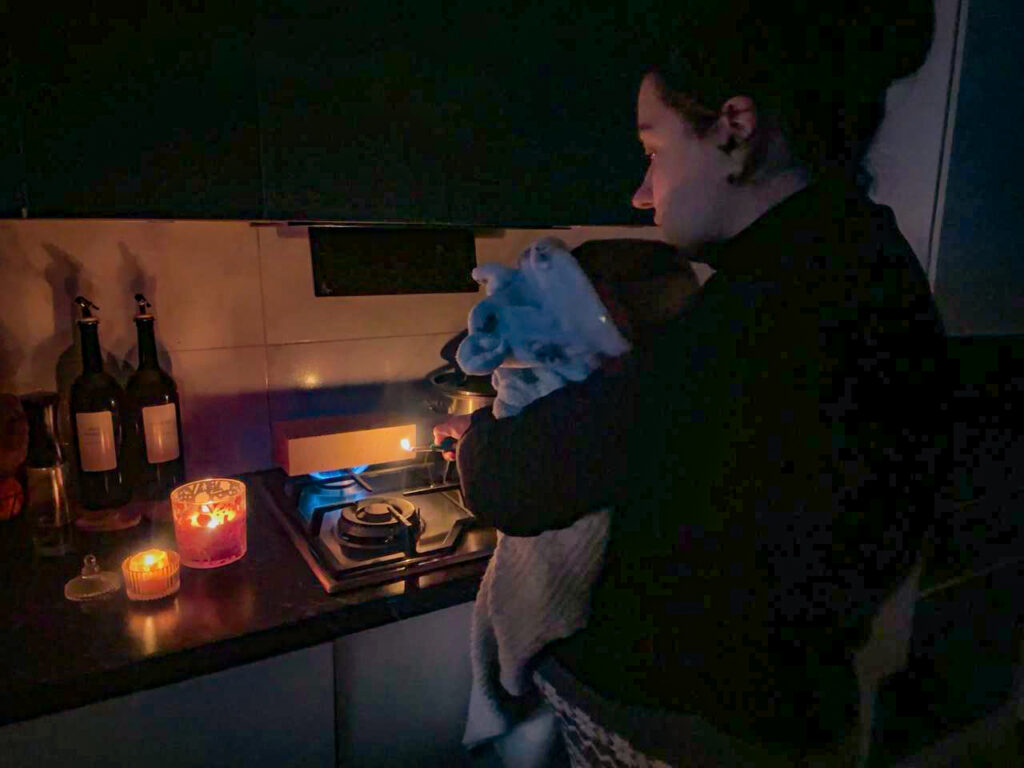
‘For a three-month-old baby, this is critically low. It is impossible to properly change or bathe the baby. I am constantly afraid that she will catch a cold. I wrap her in a warm blanket, with two or three layers of warm clothes underneath. When it gets especially cold, I try to carry her in my arms as much as possible, holding her close so that she can also warm up from my body heat.’
The family has taken to placing fireproof bricks on the gas stove for a small measure of warmth. At night, that option disappears. ‘All that remains is to put on warm clothes, wrap ourselves in several blankets, and wait for morning.’
On the day of this account, electricity had been scheduled for just 3.5 hours. It never came. Repairs, she had read online, could take five to seven working days. ‘I honestly do not know what we are supposed to do.’
A Prayer Card in the Dark
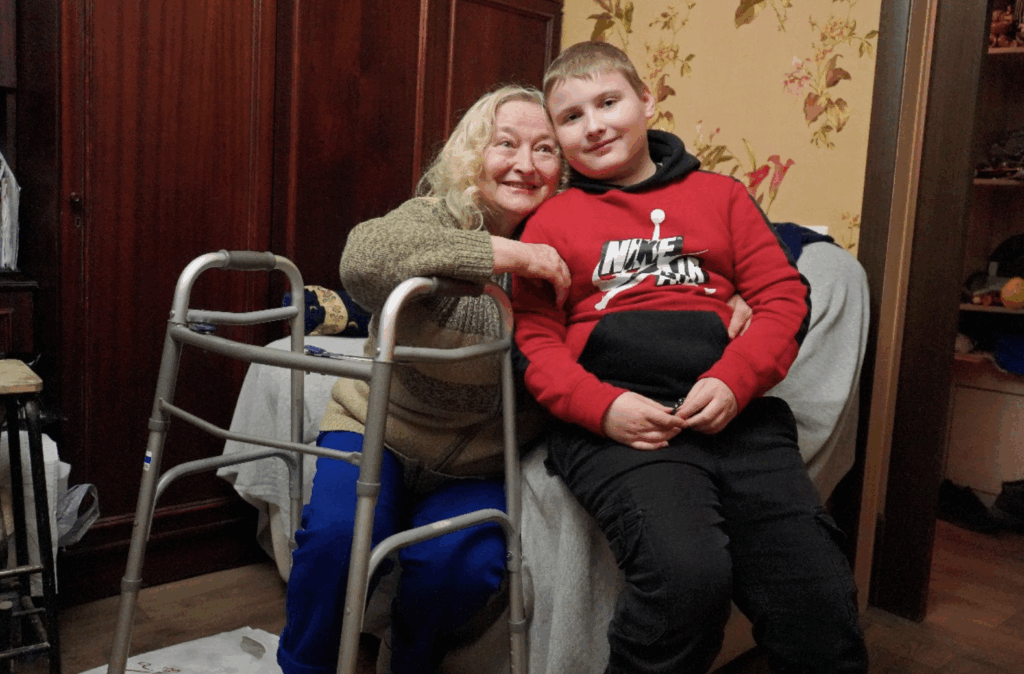
Tetyana Anatoliivna is 71 years old and has lived in Kharkiv since birth. She moves around with folding crutches, the result of a workplace injury years ago that left her bedridden and paralysed for five years. Her husband nursed her back to health. He died suddenly on New Year’s Eve 2014.
When the full-scale invasion began in February 2022, Kharkiv was struck heavily. Tetyana counted 24 shells flying over in quick succession. A bomb, dropped three streets away, threw her across the room and under the sofa. Then came the occupation.
‘I saw the Russian occupier approach a car, take out an automatic weapon, and fire three rounds from around the corner toward the road. So that no one would see him. He was intimidating people. But the people who were standing in line for bread continued to stand there. The shooting, a tank rushing by, and people just waiting for their bread. I will never forget that image.’
Her grandson Artem, now eight, came to live with her a year ago. His father, Tetyana’s son, was mobilised after being stopped at a checkpoint while driving the boy to Kharkiv. Artem developed a nervous tic after the shelling. He stopped talking. Doctors and a speech therapist have been working with him.
The support from Caritas allowed Tetyana to buy winter boots and warm clothes for both of them, pay utility bills, and cover some of Artem’s medication. She had submitted the application without much hope. ‘Because there are so many people in need right now.’ When the confirmation arrived, she wept.
A staff member at Caritas gave Artem a prayer card and told him to read it whenever he felt scared or sad. Artem draws pictures for his father, waiting for him to come home from the front. When he is older, he says, he wants to draw a portrait of his grandmother, smiling and beautiful, just as she is today.